
Our podcast will bring Roma youth voices to your ears.
Romanipe shows the modern variation of traditional Roma professions
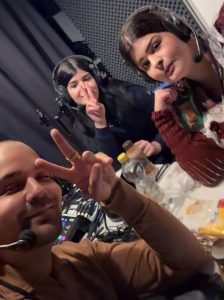
In the Romanipe project, Roma youth from Finland and Latvia created a podcast series in which they tell about their education, employment and life. The true stories increased Roma youths’ awareness of the richness and diversity of their own community and empowered them to take the next step in their career paths towards their dreams. Hopefully also the stereotypes of mainstream people on Roma youth are shaken, as the playlist shows that Roma youth are ultimately not that different from any other youth.
Conclusions from the project
The knowledge-based youth work was strengthened along with the project. Although the Romanipe project did not conduct research, nor can its results be generalised to all Roma youth, some conclusions can, however, still be drawn from it.

According to the OECD study on dream jobs, young people in Europe, including Finland and Latvia, are attracted to traditional, well-paid professions. As such, the most popular occupations for girls are doctors, teachers, business managers, lawyers, psychologists, nurses, designers, veterinary doctors, police officers and architects while becoming engineers, business managers, doctors, ICT professionals, sportsmen, teachers, police officers, motor vehicle mechanics, lawyers and architects were the top choices for boys. In the course of the Romanipe project it became apparent that the dream professions of the participants were very different to those mentioned above, namely Roma worker, make-up artist, eyelash master, tattoo artist, music producer, animator, social media influencer, pilot.
All of these professions can be seen as modern variations of traditional Roma professions, as they combine independent work, preferably in the company of their own, with creativity and craftsmanship. They also partly reflect the services that the Roma youth themselves consume, which means that these jobs are already familiar to the young Roma. More importantly, notably for the Finnish Roma, in these jobs, they can dress according to Roma culture if they want, and if they move to another location, the profession can be taken with them.
Many young Roma want to become community workers and work in their own communities. However, it is not just a matter of an altruistic desire to support the Roma people, as working in the Roma community also means that there is no fear of exclusion or racism. Working among the Roma may give certain kinds of prestige as well as an opportunity to be heard in the community. Additionally the young Roma will not be judged based on their level of education or work experience, but rather by how they fit into the community.
In the Roma community, education may be encouraged, but at the same time its benefits are doubted. If a young person studies and works within the mainstream population, the parents may be afraid that the youngsters will be isolated from the Roma community. Educated Roma tend to stop speaking “like a Roma”, and thus it may be considered that they have abandoned the Roma community. The phenomenon is the same as what is referred to as “class movement” in the mainstream population, where a young person from a working-class background feels alienated from their surroundings at university, including things such as their style or speech and sense of humor. As their studies progress, they begin to feel alienated at home as well. If their family does not understand or appreciate the academia and the discussions that take place there, talking about it may feel difficult. This may be the – even unconscious – reason why most respondents in the Romanipe project dreamed of professions that do not require extensive training and can be done independently, but which unfortunately often do not generate much income.
In order to train for a wide range of different professions, young Roma need mentoring and role models. Romanipe managed to introduce some professions, but the Finnish participants in particular were only at the very beginning of their studies and working lives. In addition, many young Roma who are working refuse to speak in public under their own names and faces, as they fear the reactions of both the mainstream population and the Roma community. In public, Roma are always expected to cheat: even if they have a good education and a job, the mainstream population simply assumes that they got there by trickery.
In the following projects, even more attention must be directed to the encouragement and motivation of Roma to study. But in order to do this, the Roma youth need adults who believe in them, and not just at home but especially in schools. It is still way too common that student counsellors do not believe that Roma pupils are just as capable as any other student. Thus they are much more likely to be steered towards jobs in the low income fields. Systematic downward guiding of Roma pupils at every stem of their career paths does not only mean that their level of education or employment does not get better. It also condemns them into lifelong poverty, which could have been avoided by supporting Roma youth more actively in school. Based on the information gained in the project, participating organisations will be able to develop their youth work in a direction that more strongly encourages young Roma to get an education and apply for professions that will actually allow them to support themselves and their families.
Link to the YouTube playlist where all the podcast episodes are freely available for listening: https://www.youtube.com/playlist?list=PLOJgfSK34RAfLvweETjEmTkCUSVXV1bw5
The Erasmus+ National Agency awarded Romanipe with Good Practice. Is is awarded to project that have been particularly well managed and could therefore be a source of inspiration to others. The final score of the project was 85.0.
Romanipe Project was implemented in 2025 by the Finnish Roma Association (Finland) and Romu Kultūras Centrs (Latvia). It was a small-scale cooperation partnership project funded by the Erasmus+ programme in the field of youth.
European commission is not responsible for the content.
More information about the Erasmus+ programme: https://erasmus-plus.ec.europa.eu/
The project gave hope and belief to our youth. It showed great examples on how it is possible to study and work even when one faces all kinds of challenges in life. Each of these young adults had found their own path and way to lead a life that felt like theirs. Another thing I really appreciated was how much these young people gave of themselves. They shared openly and honestly their views on their culture and their way of living. These kinds of in-depth interviews work best in the Roma community as they are a good example as well as show the path forward.
Ramona Schwartz, Roma activist
The playlist opens the history of the Roma culture in a truly wonderful way. It is fascinating to see how much the young people clearly value both traditions and art as well as how they talk about these topics. They are both passionate and respectful, while carrying and discussing their heritage. Even though a Roma heritage is still often seen as a hindrance in the employment market, the Roma youth themselves still define it as their great source of power. Lastly, it is important to highlight the international aspect of the Roma culture as it is both great and important.
Kirsti Rinta-Panttila, Senior Deaconess
The expertise and materials developed by Romanipe have been further utilised to support Roma communities through other projects, multiplying the impact of the original initiative. The videos and podcasts have been shared with youth and mentors in Finland as part of the EU CERV-funded project RomniMe, coordinated by the Deaconess Foundation. This was particularly important for mentors, most of whom are non-Roma, to expand their knowledge about Roma young people. The insights provided through the podcasts — on how Roma envision their futures, the challenges they face, and what gives them strength — were also used during the Erasmus+ project DigiFinMedia event on December 21, 2025. It was crucial for participants to hear and see real stories from Roma individuals, offering authentic perspectives and fostering understanding.
Anca Enache, Human Rights Specialist